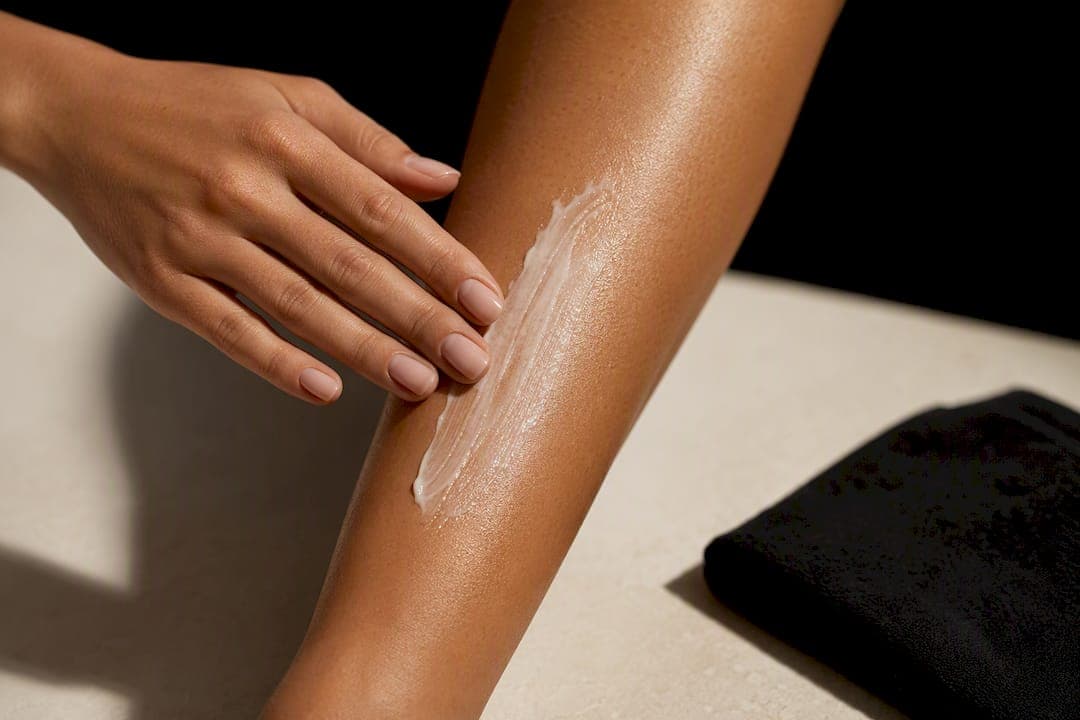
Wait until after your first rinse, then moisturise daily with a lightweight, fragrance-free, oil-free lotion. Save richer body butters for particularly dry patches or for night-time use only. Hydrated skin sheds more slowly, so colour fades evenly instead of patching. Treat hands, feet, elbows and knees more carefully than the rest of your body to stop them turning darker than everywhere else.
TL;DR:
- Use a fragrance-free, oil-free lightweight lotion after your first rinse to prevent streaking and promote even fading.
- Apply a richer, targeted moisturizer at night or on dry patches rather than on all skin areas during the day.
- Moisturize twice daily with hydrating ingredients like glycerin or hyaluronic acid to maintain skin hydration and extend tan longevity.
- Avoid heavy oils, SPF, and exfoliating acids immediately before or after tanning, as they can speed up fading or damage the tan.
- Treat dry areas like hands, elbows, and knees with light barrier creams or diluted products to prevent darker patchiness.
Table of Contents
- What is the best fake tan moisturizer for daily use?
- When should you moisturise before and after a fake tan?
- Which ingredients help or hurt a fake tan?
- Why do hands, feet and elbows tan darker than everywhere else?
- How do tan extenders fit into a moisturising routine?
- What mistakes fade a fake tan fastest, and how do you fix them?
- How does body butter support skin between tans?
- Can you keep a tan glowing without damaging your skin long-term?
- Extend your tan with After Hours Body Butter
- Sources
- FAQ
What is the best fake tan moisturizer for daily use?
Not every moisturiser earns a place in your tan routine. Four categories cover almost everything on the shelf, and each one serves a different job.
Lightweight lotions sit at the top of the list for daily use. Water-based and fast-absorbing, they hydrate without leaving a film that traps sweat or friction against your tan. Humectant gels work similarly but suit oilier or combination skin, since they draw moisture in without adding any occlusive layer. Richer creams and body butters bring heavier emollients like shea butter, and they're best reserved for targeted dry spots or an overnight barrier boost rather than all-over daytime wear. Tan extenders (low-DHA gradual tanners) sit in their own category entirely, topping up colour rather than just hydrating skin.
Water-based, humectant-rich formulas dominate daily maintenance for a reason. A review of DHA sunless tanning products notes that product vehicles interact directly with cosmeceutical additives, and lighter lotion vehicles tend to sit better against a developed tan without disturbing its surface. Heavier emollients can still play a role, just not as your go-to morning product.
When you're scanning labels, run through this checklist:
- Fragrance-free: strong perfumes can react unpredictably with DHA residue and irritate skin that's already had an active ingredient sitting on it.
- Oil-free or mineral-oil-free: mineral oil and petrolatum sit on the surface and can accelerate uneven fading.
- No SPF in your daily moisturiser: sunscreen chemicals aren't formulated to play nicely with a topical tan, and layering them daily adds unnecessary interaction.
- Look for glycerin or hyaluronic acid: both pull moisture into skin without an oily residue.
- Aloe vera: calming and lightweight, useful if skin feels tight after showering.
- Ceramides: support the skin barrier directly, which matters more than most people realise once a tan is developing.
- Shea butter: fine in small, targeted amounts, but too heavy for full-body daily use on a fresh tan.
Skin type changes which of these matters most. Dry skin benefits from ceramide- and shea-based night formulas layered under a lighter day lotion. Combination skin usually does well with a humectant gel all over, and a touch of richer product just on cheeks, elbows and knees if you're extending that logic to the face. Oily skin should stick almost entirely to gel textures and avoid anything described as "nourishing" or "rich" on the label. Sensitive skin does best with the shortest ingredient list you can find, since fewer ingredients mean fewer chances of a reaction.
Pro Tip: Keep two products in rotation, not one. A gel or lotion for daytime, and a richer, fragrance-free cream for night, gives you hydration without the risk of over-softening your tan during the day.
When should you moisturise before and after a fake tan?
Timing decides more about how your tan looks on day five than the product itself does. Here's the sequence that actually works:
- 48 hours before tanning: exfoliate thoroughly, focusing on elbows, knees, ankles and hands, to remove dead skin cells that would otherwise grab pigment unevenly.
- 2 to 3 days before: moisturise consistently, morning and night, to build up a well-hydrated base layer. Apply your last full-body moisturiser the night before tanning, giving it time to fully absorb.
- On tanning day: arrive product-free. If a patch of skin is unusually dry, use only a small amount of barrier cream on elbows, heels or knuckles, since a hydrated substrate the day before is what DHA formulation research points to for an even result.
- During development: apply nothing at all. Moisturiser applied while DHA is actively developing is one of the fastest routes to streaking, according to professional aftercare guidance.
- After your first rinse: apply moisturiser to skin that's still slightly damp, which helps lock hydration in rather than sitting on top of dry skin.
- Ongoing maintenance: twice daily is usually enough. Morning and evening application keeps the tan looking fresh without over-treating skin.
Technicians generally recommend allowing adequate time for any pre-tan moisturiser to fully absorb before self-tanner goes on, since a lotion that hasn't sunk in yet can dilute or block the tanning process.
Which ingredients help or hurt a fake tan?
Certain ingredients actively support your tan; others quietly undo it. Knowing the difference before you buy saves you from a bottle that looks premium but fades your colour in three days.
Ingredients worth choosing:
- Glycerin and hyaluronic acid, which pull water into the skin without leaving residue.
- Aloe vera, useful for calming skin after showering off developer.
- Ceramides and fatty acids, which reinforce the skin's barrier over time.
- Shea butter, but only in smaller, targeted doses rather than all-over daily coverage.
Ingredients to avoid, particularly right before or after tanning:
- Mineral oil and petrolatum, which sit on the surface and interfere with even fading.
- Heavy plant oils like coconut oil, for the same reason.
- SPF-containing moisturisers, which introduce chemical interactions with residual DHA.
- Alcohol-heavy formulas, which can dry skin out and speed up flaking.
- Strong fragrances, which raise irritation risk on freshly tanned skin.
- Exfoliating acids (AHAs, BHAs) and retinoids, which actively strip pigmented skin cells.
Formula structure matters too. Water-in-oil formulas absorb more slowly and leave more product sitting on the surface, while oil-in-water lotions sink in faster and interact less with a developing or developed tan. Analytical evaluation of sunless tanning formulations found that formulation differences, not DHA concentration alone, changed how uniform and long-lasting the final colour appeared.
For sensitive skin specifically, a short, simple ingredients list reduces the odds of irritation compounding on top of a tan that's already stressing the skin barrier slightly. A clinical study on emollient-rich moisturisers found twice-daily use with hyaluronic acid, natural moisturising factors and lipids produced measurable hydration gains at two, four and eight weeks, which supports choosing a structured, simple formula over a long ingredient list promising everything at once.
Why do hands, feet and elbows tan darker than everywhere else?
These joints and extremities have drier skin and a thinner outer layer, so they soak up more pigment than smoother areas like your forearms or thighs. That's the entire reason technicians treat them differently rather than applying tan the same way everywhere.
A few adjustments prevent the orange-knuckle problem:
- Apply a very light barrier cream to hands, feet, elbows and knees on tanning day, or moisturise them lightly the night before instead.
- Tan these areas last, using whatever product is left on your mitt rather than a fresh application.
- Dilute the product slightly at joints by blending it in with a barely-there sweep rather than a direct application.
- After tanning, moisturise these spots lightly but more often than the rest of your body.
- If edges look harsh after a day or two, buff gently with a damp cloth rather than scrubbing.
How do tan extenders fit into a moisturising routine?
Tan extenders are moisturisers with a small amount of DHA mixed in, designed to top up fading colour rather than deliver a full tan. They're a maintenance tool, not a replacement for your main application.
- Use extenders only after your first rinse from a full tan, never as a substitute for pre-tan preparation.
- Stop using an extender at least 48 hours before a fresh, full-coverage tan, since layering low-DHA product on top of new self-tanner risks uneven build-up.
- Fold an extender into your existing daily moisturising step rather than treating it as an extra product, applying it exactly where colour looks like it's fading first.
Daily moisturising after the first shower is what actually slows fading, and extenders simply give that routine a small colour top-up rather than doing the heavy lifting themselves.
What mistakes fade a fake tan fastest, and how do you fix them?
Most tan disasters trace back to one of four habits, and every one of them is fixable.
- Moisturising during development causes streaking because the product interrupts the DHA reaction mid-way. Fix it by leaving skin alone until after your first shower, then correcting patches a few days later with gentle exfoliation and a spot of gradual tanner.
- Daily heavy oil use speeds up fading unevenly. Swap to an oil-free lotion for day use and keep richer products for night only.
- Reintroducing acids too soon strips colour fast. Wait until your tan has largely faded before bringing AHAs or retinoids back into your routine.
- Patchiness that's already happened responds well to a short repair plan: gentle exfoliation, consistent light moisturising, then a spot application of gradual tanner over three days to even things out.
Pro Tip: If you notice patchiness forming, resist the urge to scrub it away immediately. A gentle three-day correction plan blends far more evenly than one aggressive exfoliation session.
How does body butter support skin between tans?
Vegan, cruelty-free formulations built around fat-soluble vitamins are designed to support the skin barrier without synthetic fillers, which matters once you're moisturising daily to protect a developing tan. That's the principle behind Afterhoursbodybutter's approach to hydration.
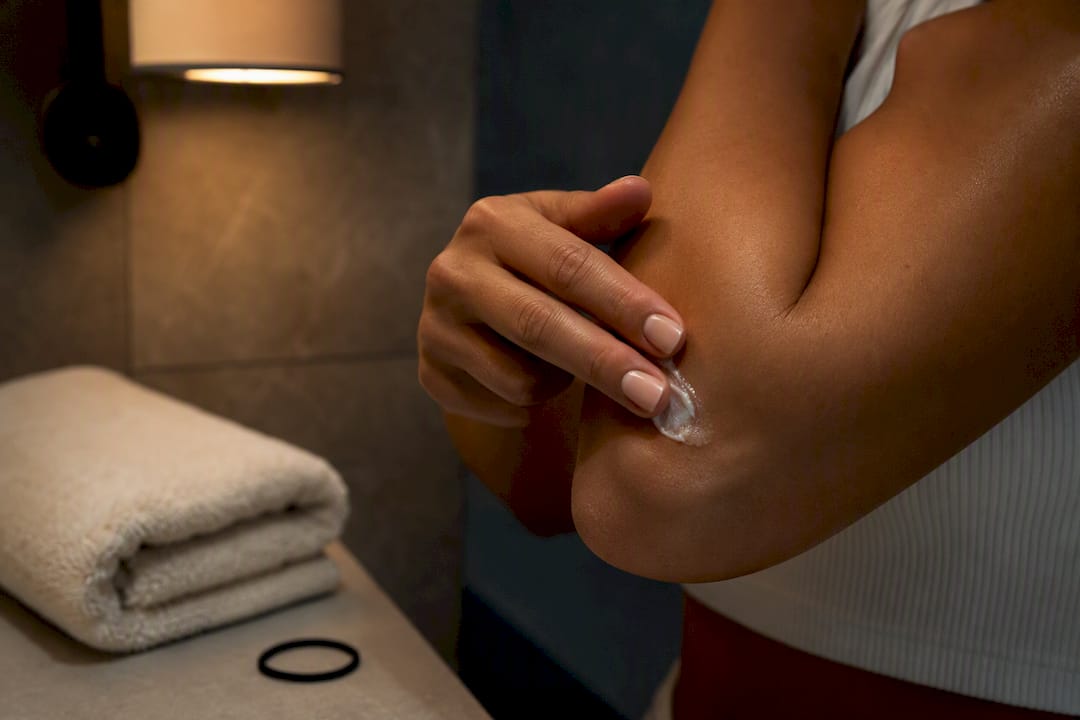
The technique that works best after your first rinse is targeted, not lavish. Use a small amount, focus on drier areas like elbows and shins, and save the richer application for night rather than layering it on before you've dressed for the day. Applied this way, a body butter's deeper absorption supports skin recovery overnight without leaving a residue that interferes with colour during the day.
Can you keep a tan glowing without damaging your skin long-term?
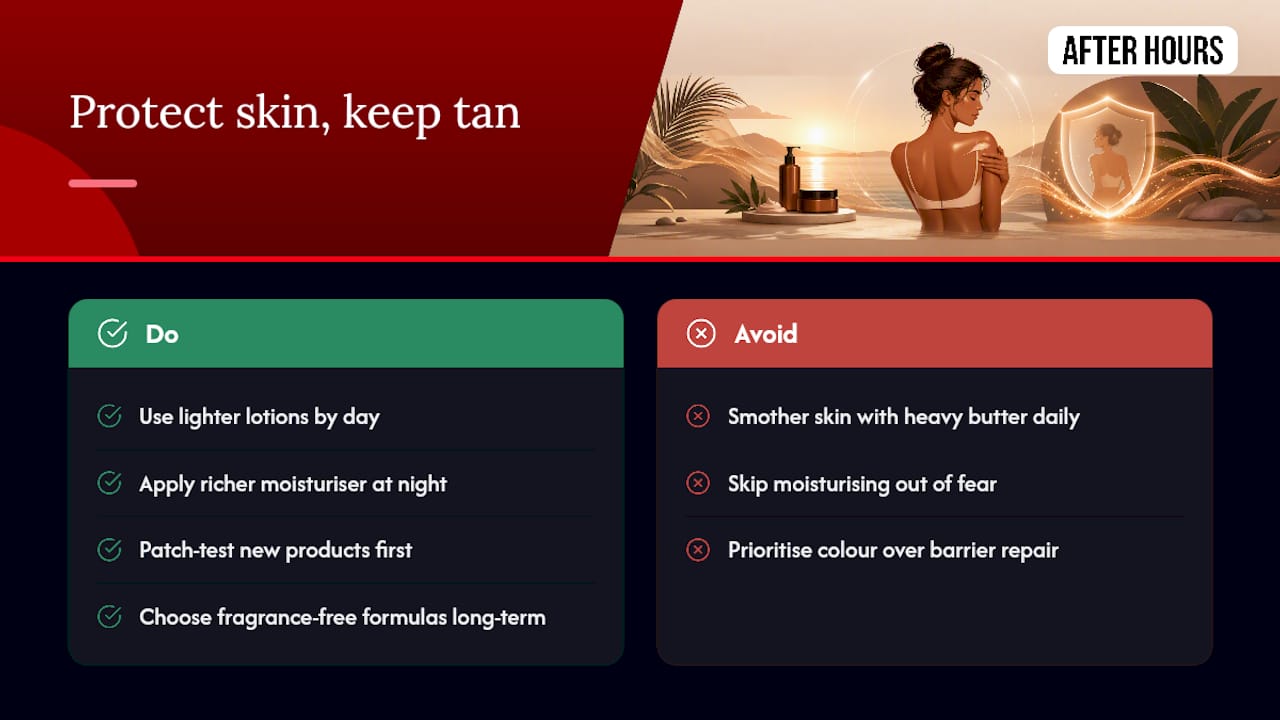
The honest answer is that most people over-correct in one direction. They either drown themselves in heavy butter every day, which risks softening colour too fast, or they avoid moisturising altogether out of fear of ruining the tan, which dries skin out and makes it flake sooner.
The better balance is straightforward: lighter lotions for daytime aesthetics, richer applications at night when barrier repair matters more than colour preservation. Whatever you choose, patch-test anything new on a small area first, and lean towards fragrance-free formulas as a long-term habit rather than a tan-specific one. Skin health outlasts any single tan.
— Darnell
Extend your tan with After Hours Body Butter
Vegan, cruelty-free butters built around fat-soluble vitamins are designed to support the skin barrier without synthetic fillers, which matters once you're moisturising daily to protect a developing tan.
Use it sparingly on joints like elbows and knees, apply it after your first rinse rather than before, and reach for it at night when your skin has time to absorb it fully before your next tan-safe daytime lotion goes on. For a closer look at how to apply body butter for the best results, or to browse the full range, visit the Body Butters collection and find the formula that suits your skin.
Sources
This article draws on a peer-reviewed review of DHA formulation, clinical moisturiser research, practical guidance from Talking Tan, and The Guardian's tested fake tan review.
- Sunless tanning products: formulation and performance (PMC10083914)
- Emollient-rich moisturiser supporting HA, NMF and lipids (Journal of Cosmetic Dermatology)
- Should you moisturise before a spray tan? (Talking Tan)
- Lotion after a spray tan: when and what to apply (Talking Tan)
FAQ
What is the best moisturizer for self-tanners?
A lightweight, fragrance-free, oil-free lotion works best for daily use after a self-tan, since it hydrates without leaving a film that disrupts colour. Richer body butters, including Afterhoursbodybutter's vegan formulations, suit targeted dry spots or night-time use rather than all-over daytime application.
What is the most hydrating fake tan moisturizer?
Emollient-rich formulas containing hyaluronic acid, natural moisturising factors and lipids delivered the strongest hydration results in clinical testing, with measurable improvements at two, four and eight weeks of twice-daily use. Look for these ingredients on the label rather than relying on "hydrating" marketing claims alone.
Should I put moisturizer over fake tan?
Yes, but only after your first rinse or shower, never during the active development window. Applying moisturiser too early causes streaking, while daily application afterwards is what actually slows fading and keeps colour even.
How does fake tan moisturiser work?
It keeps the outer layer of skin, the stratum corneum, hydrated so it sheds more slowly, which means the tanned cells stay on the surface longer instead of flaking away unevenly. A well-hydrated substrate is also what supports an even tan result in the first place, according to formulation research.
How often should I moisturise to make my tan last?
Twice daily, morning and evening, is generally enough to maintain a tan for the typical five to seven days most tans last, according to consumer testing. Hot, humid conditions or heavy sweating may call for a light top-up in between.