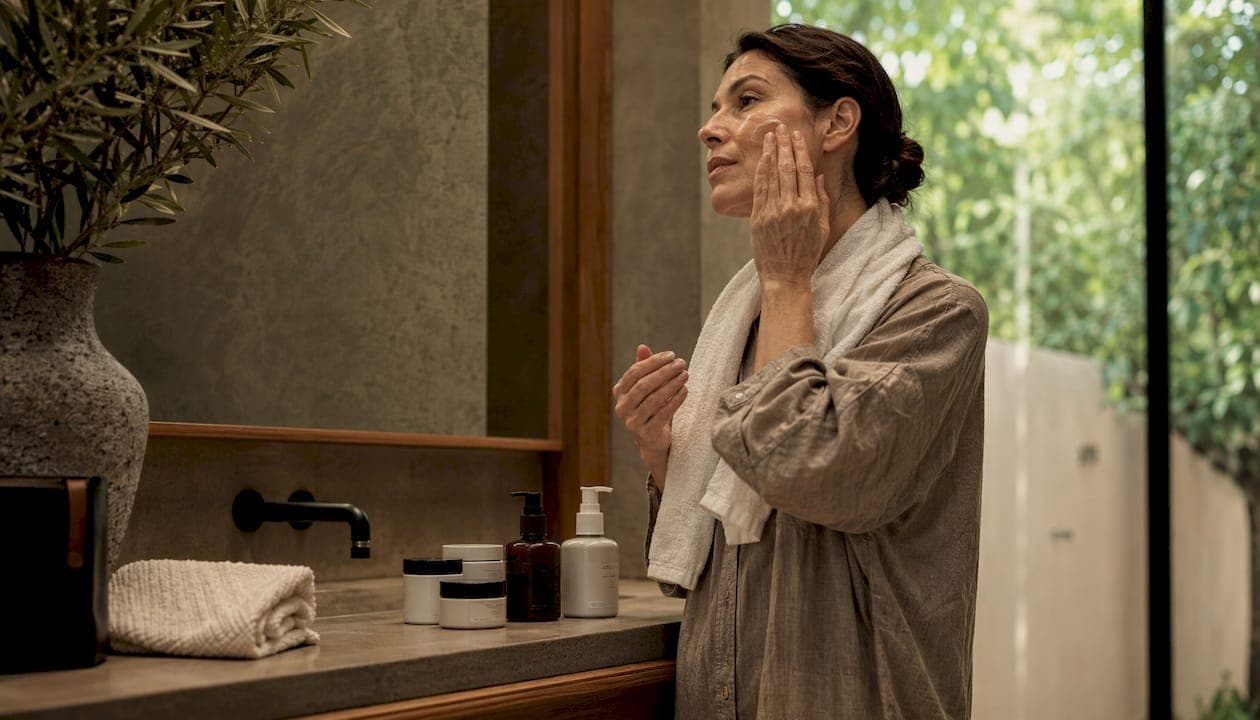
Deep skin moisturising means two things working together: getting usable water into the stratum corneum (the outermost skin layer) and stopping that water from escaping. Neither function alone is enough. You need a humectant to draw water in, and a barrier ingredient to seal it there. That is the fill-and-seal principle, and it is the basis of every effective moisturising routine.
- Fill: Humectants (glycerin, hyaluronic acid, urea) attract water into skin cells.
- Seal: Occlusives and barrier lipids (ceramides, petrolatum, squalane) lock that water in by reducing transepidermal water loss (TEWL).
- Quick routine: Apply your humectant to damp skin, follow with a barrier cream, then add an occlusive on top only if your skin is very dry or it is winter.
Pro Tip: Apply your moisturiser within 3 minutes of towelling off. Your skin still holds residual water at that point, and your humectant has something to work with. Wait longer and you are sealing in much less. Wait longer and you are sealing in much less.
Table of Contents
- What does 'deep hydration' actually mean for your skin?
- How moisturisers work: ingredient classes and what each one does
- How to build a routine that achieves deeper hydration at home
- Choosing products safely in the UK and guidance for sensitive or older skin
- How researchers measure 'deep' hydration and what that means for product claims
- Common myths, mistakes, and quick troubleshooting for stubborn dryness
- Key takeaways
- The part most skincare advice skips
- Afterhoursbodybutter: vegan body care built on barrier science
- Useful sources and further reading
What does 'deep hydration' actually mean for your skin?
The word "deep" gets used loosely in skincare marketing. Understanding what it means scientifically helps you judge product claims accurately.
Your skin has three main layers. The dermis sits deepest and is rich in water. Above it is the viable epidermis, and at the surface is the stratum corneum, a thin stack of flattened dead cells held together by a lipid matrix. Water naturally flows upward from the dermis toward the surface, where it evaporates. The stratum corneum typically holds a water content that varies; below a certain threshold, skin feels tight, flaky, and rough.

Consumer moisturisers work primarily at the stratum corneum level. That is not a limitation to apologise for. Restoring water content and barrier integrity there produces real, visible results. The problem arises when brands claim their product hydrates the dermis or "deep layers" based on standard consumer testing.
Most over-the-counter testing uses electrical impedance or corneometry, which measures conductance in the outermost stratum corneum. It cannot tell you what is happening in the viable epidermis or dermis. Methods that can probe deeper include confocal Raman spectroscopy and near-infrared (NIR) spectroscopy, both of which map water distribution across skin depth. These are research-grade tools, not standard brand testing.
- Consumer corneometry: measures surface stratum corneum only.
- Confocal Raman spectroscopy: maps water concentration at different skin depths.
- NIR spectroscopy: non-invasive, can probe into the viable epidermis.
- Clinical procedures (e.g. injectable hyaluronic acid): the only route to reliably increase dermal water content.
What this means practically: topical products that claim "deep dermal hydration" without citing Raman or NIR data are overstating their evidence. A product that genuinely improves stratum corneum hydration and reduces TEWL is doing exactly what a topical moisturiser can do, and that is worth having.

How moisturisers work: ingredient classes and what each one does
Moisturisers are combinations of humectants, emollients, and occlusives, sometimes with added barrier-repair lipids. Each class does a different job.
The three core classes:
- Humectants draw water from the environment or from deeper skin layers into the stratum corneum. Examples: glycerin (glycerol), hyaluronic acid, urea, sodium PCA, aloe vera.
- Emollients fill gaps between skin cells, smoothing texture and improving flexibility. Examples: shea butter, jojoba oil, squalane, dimethicone.
- Occlusives form a physical barrier on the skin surface to slow water evaporation. Examples: petrolatum, beeswax, lanolin, zinc oxide, and lighter modern alternatives such as plant-derived squalane or dimethicone.
- Barrier-repair lipids restore the lamellar matrix that controls TEWL. The key trio is ceramides, cholesterol, and free fatty acids, applied in physiological ratios for best results, particularly in aged or compromised skin.
| Ingredient class | Primary function | Typical examples | When to prioritise |
|---|---|---|---|
| Humectant | Draws water into stratum corneum | Glycerin, hyaluronic acid, urea | Dehydrated, tight, or flaky skin |
| Emollient | Smooths and softens skin texture | Shea butter, squalane, jojoba | Rough texture, general dryness |
| Occlusive | Reduces TEWL at the surface | Petrolatum, beeswax, dimethicone | Very dry skin, winter, eczema-prone |
| Barrier-repair lipid | Restores lipid matrix, controls TEWL | Ceramides, cholesterol, fatty acids | Aged skin, damaged barrier, eczema |
One interaction effect matters a lot: a humectant used alone in a dry or cold climate can pull water from deeper epidermal layers to the surface, where it then evaporates. The result is paradoxical dehydration. Always follow a humectant with an emollient or occlusive to trap what you have drawn up.

Pro Tip: Glycerin has strong in vivo barrier-repair properties and tends to produce longer-lasting effects than hyaluronic acid in barrier-focused routines. If your skin is mature or very dry, check that glycerin appears near the top of the ingredients list, not just as a minor addition.
How to build a routine that achieves deeper hydration at home
The thin-to-thick principle governs layering: apply the lightest, most water-based products first, then work toward heavier, more occlusive ones. Applying a rich cream before a serum can hinder the serum from reaching the stratum corneum.
Morning routine
- Rinse with cool or lukewarm water (no cleanser needed unless your skin is oily).
- Pat skin until just slightly damp, not bone dry.
- Apply your humectant serum or toner (glycerin-based, hyaluronic acid, or urea).
- Follow immediately with your moisturiser (emollient-rich, ideally with ceramides).
- Finish with SPF 30+ if going outdoors.
Evening routine
- Cleanse with a low-pH, fragrance-free cleanser.
- Pat to damp.
- Apply humectant serum.
- Apply ceramide-rich moisturiser or barrier cream.
- For very dry patches or winter skin: add a thin layer of occlusive (petrolatum, plant-based balm) on top.
Variant notes:
- Oily or acne-prone skin: Use a non-comedogenic occlusive such as dimethicone or squalane rather than petrolatum. Keep the moisturiser lightweight (gel-cream format).
- Mature skin: Prioritise ceramide and cholesterol content in your moisturiser. Add an occlusive step in winter.
- Eczema-prone skin: Apply moisturiser immediately after bathing, every day. Consult your GP before adding new actives.
Dos and don'ts:
- Keep showers short (5 minutes or less) and use lukewarm water to avoid stripping barrier lipids.
- Choose gentle, low-pH cleansers. High-pH soaps disrupt the acid mantle.
- Limit exfoliation to once or twice a week at most. Over-exfoliation removes the lipid matrix faster than it can repair.
- Do not skip the occlusive step in very dry or cold conditions.
Pro Tip: For stubborn dry patches on elbows, knees, or heels, apply a thick layer of a ceramide-rich cream, then cover with a thin occlusive. Leave it overnight. This "wet wrapping lite" approach accelerates local barrier repair without needing a prescription product.
Visible texture improvement typically appears within a few weeks of a consistent routine. Full barrier repair usually requires a longer period of continued care.
Choosing products safely in the UK and guidance for sensitive or older skin
UK shoppers have a wide range of options across pharmacies, supermarkets, and specialist retailers. Reading labels carefully saves money and reduces the risk of irritation.
What to look for:
- Humectants include glycerin, urea in concentrations appropriate for the severity of dryness, sodium hyaluronate, and panthenol.
- Barrier lipids: ceramide NP, ceramide AP, ceramide EOP, cholesterol, linoleic acid.
- Emollients: squalane, shea butter, cocoa butter, jojoba oil.
- Occlusive options (lighter): dimethicone, cyclomethicone, plant-based waxes.
What to avoid for sensitive skin:
- Fragrances and parfum (common irritants).
- High-pH soaps and foaming cleansers with sodium lauryl sulphate.
- Alcohol denat high in the ingredients list (drying and irritating).
- Unnecessary preservatives such as methylisothiazolinone (MI), flagged by dermatology bodies for contact sensitisation.
For post-procedure skin or after professional treatments, post-treatment skincare guidance recommends prioritising barrier repair with gentle humectants and ceramide creams before reintroducing any actives.
When to see your GP or a dermatologist:
- Persistent xerosis (dry skin) that does not respond after 4–8 weeks of a correct routine.
- Widespread dermatitis, severe itch, or visible inflammation.
- Cracked, bleeding skin or signs of secondary infection (weeping, crusting, warmth).
- Suspected eczema or psoriasis: these require clinical diagnosis and may need prescription emollients or topical steroids.
Red flags that need prompt attention:
- Worsening flaking despite a correct routine.
- Severe itch that disrupts sleep.
- Cracked or bleeding skin.
- Any sign of infection.
The NHS provides free guidance on dry skin and eczema via NHS.uk, and your GP can refer you to a dermatologist if needed. Patch test any new product on your inner arm for 24–48 hours before applying it to your face or a large body area.
How researchers measure 'deep' hydration and what that means for product claims
Understanding the science behind testing helps you evaluate what a brand's "clinically proven" claim actually covers.
Standard consumer testing (corneometry / electrical impedance):
This is the most common method. A probe measures electrical conductance at the skin surface, which correlates with water content in the outermost stratum corneum. It is quick, non-invasive, and widely used. Its limit: it cannot tell you anything about hydration below the stratum corneum surface.
Advanced methods for deeper measurement:
- Confocal Raman spectroscopy: Maps water concentration at specific depths by analysing molecular vibrations. Can profile the full stratum corneum and into the viable epidermis.
- Near-infrared (NIR) spectroscopy: Penetrates further than Raman in some configurations; useful for broader depth profiling.
- Optical coherence tomography (OCT): Structural imaging that can visualise stratum corneum thickness and hydration-related changes.
Testing time points for 'long-lasting' claims:
Industry guidance recommends measuring at multiple time points to support a "long-lasting" moisturisation claim. The standard sequence is T0 (baseline), T+4h, T+24h, T+48h, and T+72h. A product tested only at T0 and T+4h cannot support a 24-hour or 72-hour claim. Industry testing guidance published in 2026 sets out these requirements for brands making deep or long-lasting hydration claims.
Evidence checklist for evaluating a brand's claim:
- Which measurement method was used? (Corneometry only = surface stratum corneum.)
- Were multiple time points measured? (T0 to T+72h minimum for a long-lasting claim.)
- Was the study peer-reviewed or independently conducted?
- What was the sample size? (Fewer than 20 participants is weak evidence.)
- Does the claim match the method? ("Dermal hydration" requires Raman or NIR data, not corneometry.)
Common myths, mistakes, and quick troubleshooting for stubborn dryness
Myth: a richer cream always means deeper hydration. Texture and richness reflect the emollient and occlusive content, not the humectant level. A heavy cream with no glycerin or urea adds very little water to the stratum corneum. Product order matters more than product weight.
Myth: drinking more water quickly fixes dry skin. Systemic hydration supports overall health, but the stratum corneum gets its water from below (the dermis) and from topical application, not directly from drinking. Increasing water intake alone will not resolve xerosis within days.
Myth: more exfoliation helps dry skin absorb products better. Exfoliation removes dead cells and can temporarily improve product penetration. But over-exfoliation strips the lipid matrix, worsens TEWL, and creates the very dryness you are trying to fix. Once or twice a week is the upper limit for most skin types.
Common layering mistake: Applying a rich emollient cream before a humectant serum blocks the serum from reaching the stratum corneum. Always apply the lightest, most water-based layer first.
Troubleshooting stubborn dryness:
- Check your cleanser: high-pH or foaming cleansers strip barrier lipids daily, undoing any product benefit.
- Shorten and cool your showers. Hot water removes surface lipids faster than any moisturiser can replace them.
- Check your home humidity. Central heating drops indoor humidity significantly in winter; a basic humidifier helps.
- Simplify your routine. If you are using multiple actives (retinoids, AHAs, vitamin C), reduce frequency and rebuild with a basic humectant + ceramide cream first.
- If you use topical steroids, use them only as directed. Overuse thins the skin and worsens barrier function over time.
- If symptoms persist beyond 4–8 weeks of a correct, simplified routine, see your GP. Persistent dryness can indicate an underlying condition such as eczema, psoriasis, or hypothyroidism.
Key takeaways
Deep skin moisturising requires both a humectant to draw water into the stratum corneum and a barrier ingredient to seal it in, applied to damp skin in the correct order.
| Point | Details |
|---|---|
| Fill and seal | Use a humectant first, then a barrier cream; both steps are needed for lasting hydration. |
| Timing matters | Apply moisturiser within 3 minutes of bathing to capture residual skin water. |
| Layering order | Lightest product first; applying cream before serum blocks humectant absorption. |
| 'Deep' claims | Most consumer tests only measure the stratum corneum surface; true depth requires Raman or NIR data. |
| Afterhoursbodybutter | Offers vegan, ceramide-supportive formulations designed around the fill-and-seal principle for barrier-friendly daily use. |
The part most skincare advice skips
The fill-and-seal framework is well established. What gets less attention is how quickly routine habits undo it.
A five-minute hot shower with a high-pH body wash strips more barrier lipid than most moisturisers replace in a single application. Do that daily and no product, however well formulated, can keep pace. The science consistently shows that behavioural change, specifically shorter showers, cooler water, and gentler cleansers, is as important as what you apply afterwards. Yet most skincare content focuses almost entirely on products.
There is also a tendency to conflate product richness with efficacy. A dense, heavy cream feels like it is doing more. But if it lacks glycerin or urea near the top of the ingredients list, it is primarily an emollient, smoothing texture without meaningfully increasing stratum corneum water content. The correct product order, humectant first, then cream, is often the deciding factor in whether deeper moisturisation is achieved at all. That is a formulation and application insight, not a marketing claim, and it is worth holding onto when you read labels.
For most people, the answer is simpler than the market suggests: a glycerin-based serum, a ceramide-rich cream, and a consistent routine that does not strip the barrier in the first place.
Afterhoursbodybutter: vegan body care built on barrier science
If you want a straightforward option that puts the fill-and-seal principle into practice, Afterhoursbodybutter formulates its body butters around natural humectants, barrier-supportive lipids, and plant-based emollients, with no synthetic fragrances or harsh stripping agents. The focus is on ingredients your skin can actually use: glycerin for water retention, plant butters for emollient coverage, and ceramide-supportive actives to help maintain the lipid matrix.
Free UK delivery on orders over £30. No subscription needed.
For severe eczema, cracked or bleeding skin, or any sign of infection, see your GP or a dermatologist before starting a new product routine.
View the full range at Afterhoursbodybutter and find a formulation that fits your skin type and routine.
Useful sources and further reading
Short annotations to help you verify claims and read deeper.
- Moisturisers — StatPearls, NCBI Bookshelf: Peer-reviewed clinical overview of moisturiser ingredient classes, TEWL, and barrier repair. The primary reference for the fill-and-seal framework and ceramide ratios.
- How to moisturise your skin — Harvard Health: Practical dermatologist-aligned guidance on shower habits, cleanser choice, and timing. Useful for the routine and dos-and-don'ts sections.
- Moisturisers: do they work? — Harvard Health: Covers petrolatum as the benchmark occlusive and contextualises modern lighter alternatives.
- Dermatologists' tips to relieve dry skin — American Academy of Dermatology: Patient-facing guidance from the AAD on timing, application, and product selection.
- Deep hydration claims: the science behind long-lasting moisturisation testing — Skinobs: 2026 industry guidance on measurement methods (Raman, NIR) and recommended testing time points for long-lasting claims.
- Dos and don'ts of skin hydration — WebMD: Accessible overview of humectant behaviour in different climates and the risk of paradoxical dehydration.
- Natural humectants for deep hydration — Afterhoursbodybutter: Practical guide to glycerin, hyaluronic acid, and plant-based humectants with product context.
- Strengthen your skin moisture barrier — Afterhoursbodybutter: Routine adjustments for barrier integrity, including cleanser and shower guidance.
- What makes moisturiser effective — Afterhoursbodybutter: Explains fill-and-seal mechanics and label-reading tips for UK shoppers.
- Skin rejuvenation best practices — Cosmolaser: Clinic-level guidance on integrating hydrating products with professional treatments.