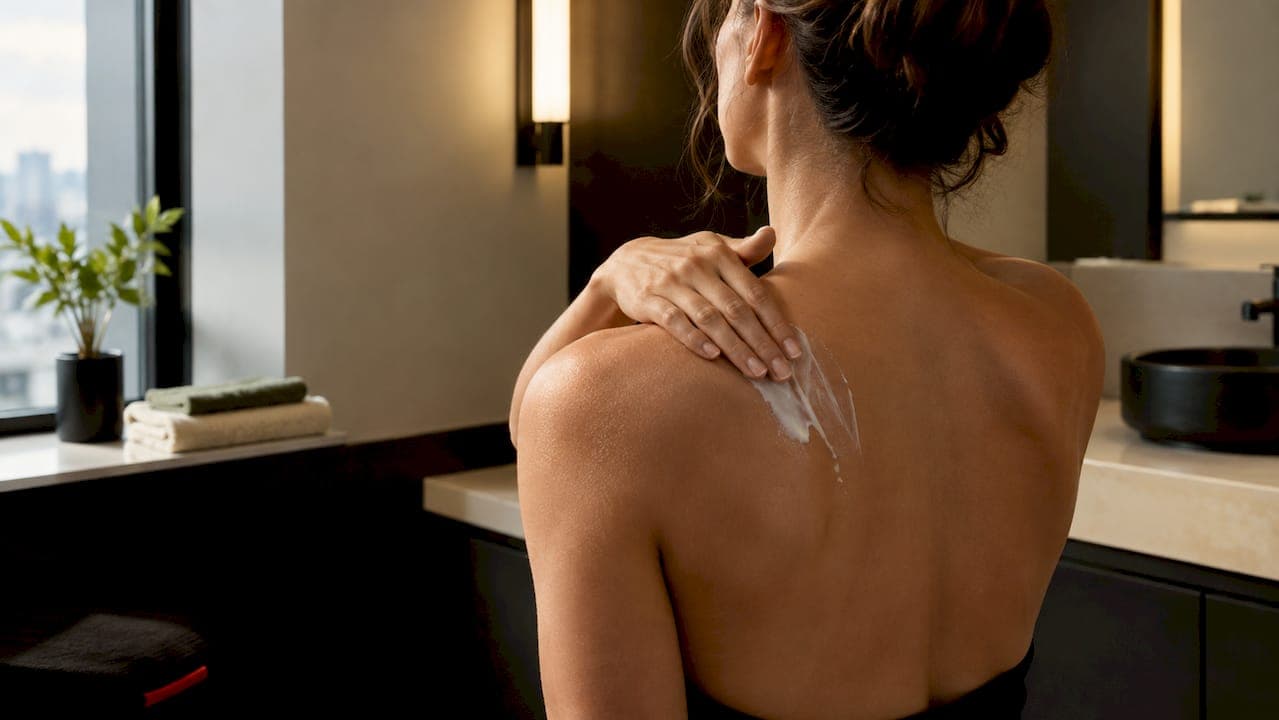
A body butter can help protect and soothe acne-treated back skin, but it is not an acne medicine. Choose a non-comedogenic, fragrance-free, fast-absorbing formula, apply it thinly after any active treatment has settled, and patch-test before committing to daily use. If irritation persists beyond a few weeks, speak to a pharmacist rather than switching products at random.
TL;DR:
- Using a lightweight, fragrance-free, non-comedogenic body butter enhances the effectiveness of acne treatments by reducing irritation without feeding breakouts.
- Applying body butter after the treatment has fully absorbed, typically 10 to 15 minutes, prevents dilution of medicated products like benzoyl peroxide or retinoids.
- Proper back acne care involves gentle cleansing with a syndet, avoiding abrasive scrubs, and wearing sweat-wicking fabrics to minimize flare-ups.
- Patience is crucial, as visible improvement often takes two to three months, with full results emerging within six months of consistent skincare.
- Severe symptoms such as deep nodules or scarring should prompt consultation with a pharmacist or dermatologist within a shorter timeframe.
Table of Contents
- What causes back acne and why this area needs different care
- Can moisturiser really help acne-prone skin?
- How do you pick the right back acne moisturiser?
- When should you apply body butter with acne treatment?
- Which After Hours Body Butter suits acne-prone back skin?
- What is a realistic timeline for clearer back skin?
- When should you see a pharmacist or dermatologist?
- Afterhoursbodybutter: built for treatment-stressed skin, not against it
- Sources
- FAQ
What causes back acne and why this area needs different care
Back acne, often shortened to bacne, forms the same way facial acne does. Sebum and dead skin cells block a hair follicle, bacteria multiply in the trapped oil, and the immune system responds with the redness and swelling you see as a spot. The mechanism is identical wherever it happens on the body, but the back gives that process extra fuel.
The upper back and shoulders carry a higher density of sebaceous glands than most other skin, so there is simply more oil available to cause blockages. Add friction from rucksack straps or bra bands, sweat trapped underclothing, and the fact that you cannot see or easily reach the area to treat it consistently, and it becomes clear why bacne often lingers longer than facial breakouts.
A few habits make it worse without people realising:
- Using a loofah or abrasive scrub, which spreads bacteria and inflames already irritated follicles rather than clearing them
- Staying in sweaty gym kit or damp clothing after exercise instead of showering promptly
- Layering heavy, oil-rich lotions over already-congested skin
- Washing with harsh, high-pH soap bars that strip the skin barrier and trigger reactive oiliness
Dermatology guidance on back acne management recommends gentle, non-abrasive cleansing, sweat-wicking fabrics, and washing kit soon after workouts. None of that is glamorous advice, but it consistently reduces flare-ups more than any single product swap.
Can moisturiser really help acne-prone skin?
Yes, and this is the part most people get backwards. A body butter cannot clear acne on its own, but the right one makes your actual treatment work better by keeping skin comfortable enough to stick with it.
Benzoyl peroxide, salicylic acid, and topical retinoids all work by drying out or exfoliating the skin, and that drying effect is often what causes people to quit before the treatment has had a fair chance. Dermatology guidance on moisturising with acne treatment notes that studies tracking moisturiser use alongside active treatment commonly show less visible irritation and better tolerance within four to eight weeks. Skip the moisturiser and you risk a cycle where dryness triggers your skin to overproduce oil in response, which can undo the treatment's benefit.
A plain, unmedicated body butter is supportive care, not a substitute for proven actives. If your back acne is inflamed, cystic, or widespread, benzoyl peroxide or a retinoid still does the clinical heavy lifting. Moisturiser's job is to stop that treatment from making your skin miserable enough to abandon.
Not every butter is safe to use here, though. A few properties turn a soothing product into one that quietly feeds new breakouts:
- Heavy occlusive ingredients like mineral oil or thick shea concentrations that sit on the skin and can trap follicles when applied too generously
- Strong added fragrance, a common trigger for contact irritation on already-compromised skin
- Comedogenic oils such as coconut oil in high concentrations, which clog pores more readily than lighter, non-comedogenic alternatives
- Alcohol-heavy formulas that feel fast-absorbing but strip the barrier further
NICE's acne management guidance specifically advises against oil-based, comedogenic moisturisers for people managing acne, alongside twice-daily cleansing with a syndet (soap-free) cleanser rather than a traditional alkaline bar. That single swap, from bar soap to a gentle syndet wash, does more for barrier health than most people expect.
How do you pick the right back acne moisturiser?
Reading a body butter label properly takes thirty seconds and saves weeks of trial and error. Here's what to check before it goes in your basket:
- Look for "non-comedogenic" on the label. This means the formula has been assessed as unlikely to clog pores, which matters more on the back than almost anywhere else on the body.
- Choose fragrance-free or low-irritant over "lightly scented." Fragrance is one of the most common causes of contact irritation on treatment-thinned skin.
- Check for barrier-supporting ingredients, specifically glycerin, ceramides, hyaluronic acid, or niacinamide. These humectants and lipids rebuild the skin's moisture barrier without adding pore-clogging oils.
- Treat "natural" or "vitamin-rich" claims as marketing, not proof. A plant-derived ingredient can still be comedogenic; naturalness says nothing about pore-clogging risk.
- Favour a fast-absorbing texture over a thick, waxy one. A butter that sits greasy on the skin for hours is more likely to trap sweat and bacteria underneath.
A body moisturiser checklist for acne-prone skin is worth bookmarking if you're comparing several jars before buying.
Pro Tip: Do a 48-hour patch test on the inside of your forearm before applying any new body butter to your back. If treatment-dried skin reacts, it usually shows there first, and far less painfully than finding out across your shoulders.
When should you apply body butter with acne treatment?
Order and timing matter almost as much as the product itself. Get the sequence wrong and you either dilute your treatment or irritate skin that was already struggling.
The routine that dermatology and NICE guidance both point toward runs like this:
- Cleanse with a syndet (soap-free) wash rather than a harsh bar soap
- Apply your acne treatment, whether that's benzoyl peroxide, salicylic acid, or a retinoid, exactly as the label instructs
- Wait for it to fully absorb and settle, usually 10 to 15 minutes, before adding anything else
- Apply a thin layer of body butter to dry areas once the treatment has set in
Introduce one new product at a time, never a fresh treatment and a fresh moisturiser in the same week, so you can tell what caused any reaction. Photograph your back under the same lighting every week or two; it's the only realistic way to track progress on an area you cannot see in a mirror. If you notice itching, burning, or a crop of uniform new bumps rather than typical spots, stop and reassess.
For irritating actives, NICE recommends a short-contact approach: apply for around an hour, then rinse off, repeating this for several applications before working up to overnight use if your skin tolerates it. This gradual ramp-up avoids the raw, flaking skin that sends most people back to abrasive scrubs out of frustration. A full step-by-step application guide covers this in more depth if you want the specifics written out.
Pro Tip: Never layer benzoyl peroxide and a retinoid in the same application. Use one in the morning and the other at night, or follow specific advice from a pharmacist, since combining them tends to increase irritation without clarifying which product is actually causing it.

Which After Hours Body Butter suits acne-prone back skin?
Some body butter brands formulate their range around principles considered safe for congested, treatment-sensitive skin: vegan, cruelty-free ingredients, no silicones or sulfates, and a focus on fat-soluble vitamins that support the skin barrier rather than smother it. That approach lines up directly with what acne-prone back skin actually needs.
Different situations call for different variants from the range:
- Treatment-dried skin benefits from a lighter, fast-absorbing formula applied in a thin layer once benzoyl peroxide or a retinoid has settled in.
- Everyday maintenance, once your back has calmed down, suits a richer butter used to keep the barrier resilient between treatment applications.
- Anyone stacking multiple medicated products should reach for a fragrance-free body butter specifically, since fragrance is the most common trigger for irritation when the skin is already coping with active ingredients.
Whichever variant you choose, patch-test on your forearm first and introduce it gradually rather than applying it across your entire back on day one. Buying a smaller size initially, if available, is a sensible way to confirm tolerance before committing to a larger jar.
What is a realistic timeline for clearer back skin?
Patience is the ingredient most people skip, and it is usually why they give up too early. Clinical guidance on acne treatment consistently points to initial improvement within two to three months, with full benefit taking up to six.
That gap matters because irritation and folliculitis (bacterial or fungal inflammation around hair follicles) can look deceptively like fresh acne. True acne tends to show blackheads and varied-stage spots; irritation or folliculitis often appears as a sudden crop of uniform small bumps. Track your back with photos under consistent lighting, change one product at a time, and give each change a fair few weeks before judging it.
— Darnell
When should you see a pharmacist or dermatologist?
Over-the-counter care deserves two to three months before you call it ineffective, but certain signs mean don't wait that long. Severe pain, deep nodules, or any sign of scarring warrant a conversation with a pharmacist or GP sooner rather than later.
If appropriate over-the-counter treatment has genuinely had no effect after that window, clinicians can add prescription-strength topicals, oral antibiotics, hormonal treatments, or refer for isotretinoin in more persistent cases. A pharmacist can also advise on safely combining benzoyl peroxide with other actives, since stacking irritating treatments without guidance often causes more harm than either product alone.
Afterhoursbodybutter: built for treatment-stressed skin, not against it
Most body butters on the market were formulated for dry skin, full stop, with no thought given to what happens when you layer them over benzoyl peroxide or a retinoid. Some body butter brands take the starting point of vegan, cruelty-free formulas made without silicones, sulfates, or harsh fillers, built around fat-soluble vitamins that support the skin barrier rather than clog it, and some products may be produced sustainably in the UK.
That barrier-first approach matters most on the back, where treatment dryness, sweat, and friction all compete at once. If you're currently using benzoyl peroxide or a retinoid, start with a fragrance-free variant to avoid adding a second irritant into the mix, and patch-test on your forearm before your first full application. Once your skin tolerates it, you can move to richer, everyday options for maintenance between treatment cycles. Browse the full Body Butters range to find the variant that matches where your skin is right now.
Sources
For the clinical detail behind this advice, NICE's acne vulgaris guidance covers treatment introduction and cleansing recommendations, while the NHS benzoyl peroxide page explains dosing cautions. The AAD's back acne guide is the most practical read for daily habits.
- Acne vulgaris: management (NICE)
- Benzoyl peroxide: a medicine to treat acne - NHS
- Back acne: How to see clearer skin - AAD
FAQ
What body cream is good for back acne?
Look for a non-comedogenic, fragrance-free body butter with barrier-supporting ingredients like glycerin, ceramides, or hyaluronic acid. Some fragrance-free body butter options are formulated with these criteria in mind, making them suitable alongside medicated acne treatments.
What clears up back acne fast?
Nothing clears bacne overnight; clinical guidance points to initial improvement within two to three months of consistent use of benzoyl peroxide, salicylic acid, or a retinoid. A supportive moisturiser improves how well you tolerate those treatments, which in turn helps you stay consistent long enough to see results.
Which body lotion is best for back acne?
The best option is oil-free, non-comedogenic, and free from strong fragrance, since dermatology guidance links these properties to better tolerance of acne treatment without adding new pore blockages. Texture matters too: a fast-absorbing butter is less likely to trap sweat than a thick, waxy lotion.
Does back acne mean PCOS?
Back acne alone does not indicate polycystic ovary syndrome; most bacne comes from a combination of excess sebum, friction, sweat, and clogged follicles rather than a hormonal condition. If back acne appears alongside irregular periods, excess hair growth, or other hormonal symptoms, it's worth raising with a GP, but breakouts by themselves are not a reliable sign of PCOS.
How long should I trial a body butter before switching?
Give a new product several weeks at minimum, ideally matching the same two to three month window used for acne treatment itself, unless you notice itching, burning, or a sudden crop of uniform bumps. Introducing one product at a time and photographing your back regularly makes it far easier to judge whether it's actually helping.